Saturday, June 28, 2025

Hennepin to Peoria, IL

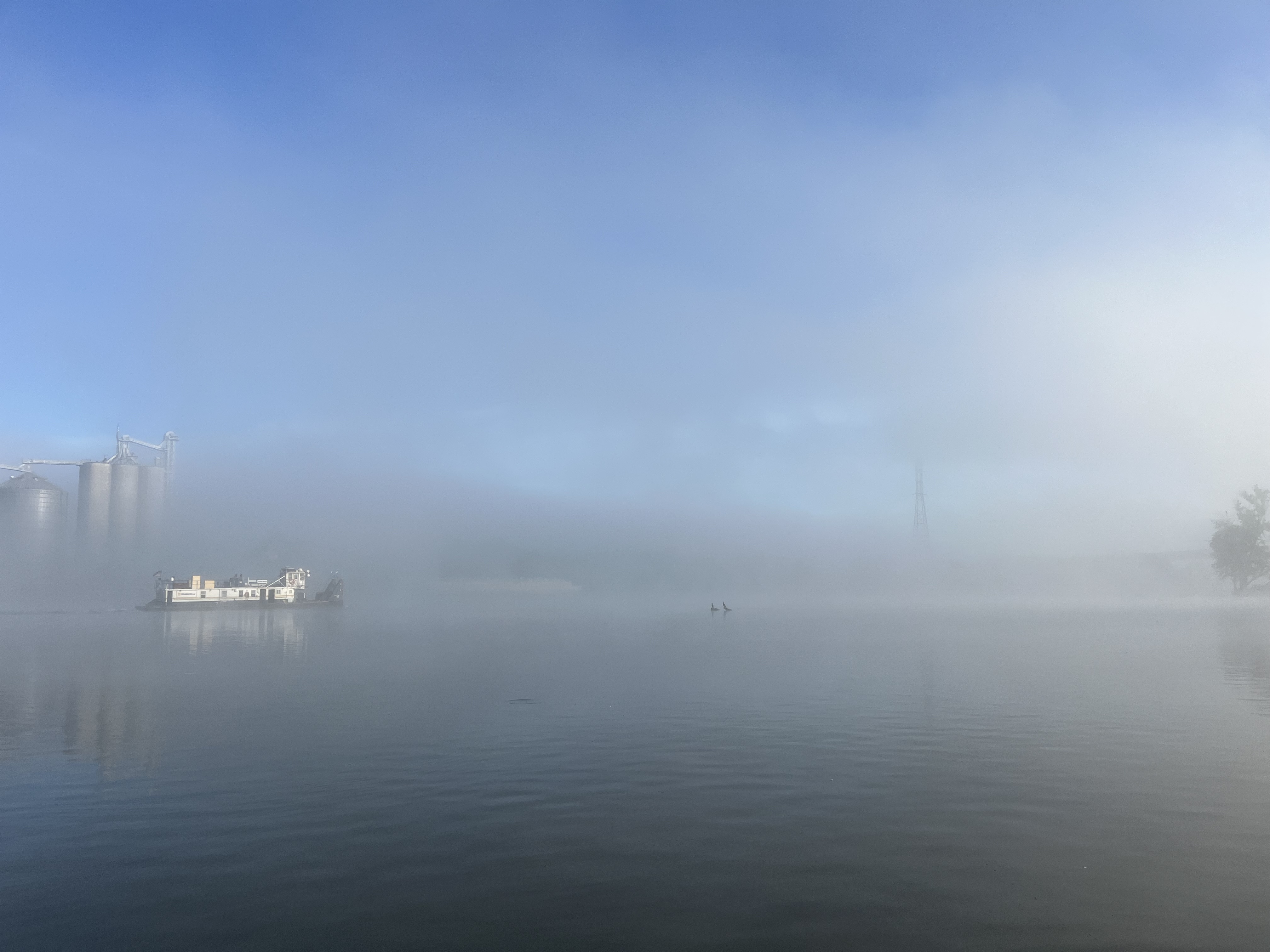
It was foggy this morning and you couldn’t even see the opposite bank of the Illinois River. Kathleen went for a run and the fog was gone by the time she returned, leaving a clear blue sky and calm conditions. We had a leisurely underway, since there were no locks on our route today and departed Hennepin into light south winds at 9:15 AM.


We saw fewer commercial tows and industrial shore facilities today and more waterfront homes and recreational boats, which were out enjoying the sunny Saturday. The river geography is also changing, with more creeks, sloughs and lakes creating large widenings in the waterway.


We traveled 44 miles today and stopped at the Peoria Boat Club, a private marina that regularly accepts transients. We were met by Doug, the friendly harbor host and Roscoe, his shitzu, who showed us the club’s air conditioned clubhouse and free laundry. Our cabin temp hit 100F this afternoon, so both were extremely welcome. Map link: Peoria, IL

Find Dragonfly. Hint: Always look for the smallest boat!


Peoria is the 8th-largest city in Illinois, the oldest European settlement in Illinois and is named for the Peoria people of the Illinois confederation. It was the whiskey capital of America prior to Prohibition and is now known as a major agricultural trading port on the Illinois River and the world headquarters of heavy equipment manufacturer Caterpillar Inc.

We got out our folding bikes and pedaled into the city, exploring a little, then stopping for Tony’s birthday dinner at Blue Duck Barbecue. After getting back to Dragonfly and stowing our bikes we showered, did laundry and hung out with Doug in the clubhouse. 

From my childhood. Perhaps it explains a lot.

Bonus Question: We have owned four Subaru automobiles and love the brand. The Subaru logo is shown below—what does it signify? (Answer below)


Bonus Question Answer: “Subaru” is the Japanese word for the Pleiades, a star cluster in the constellation of Taurus. Also called the Seven Sisters, only six stars are typically visible to the naked eye. The stars in the Subaru logo represent the companies that combined to form Fuji Heavy Industries in 1953 and became Subaru in 2017.

Ottawa to Hennepin, IL

We woke up yesterday to the sunrise over Heritage Harbor Marina, and explored the grounds, discovering the Sand Bar and the Quackerdeck, built for the local web-footed residents. 


After breakfast and pre-underway preparations, we were the fuel dock’s first customer of the day, then headed downriver into a moderate headwind. It was mercifully cloudy and the breeze and occasional bow spray felt good after so much hot weather.

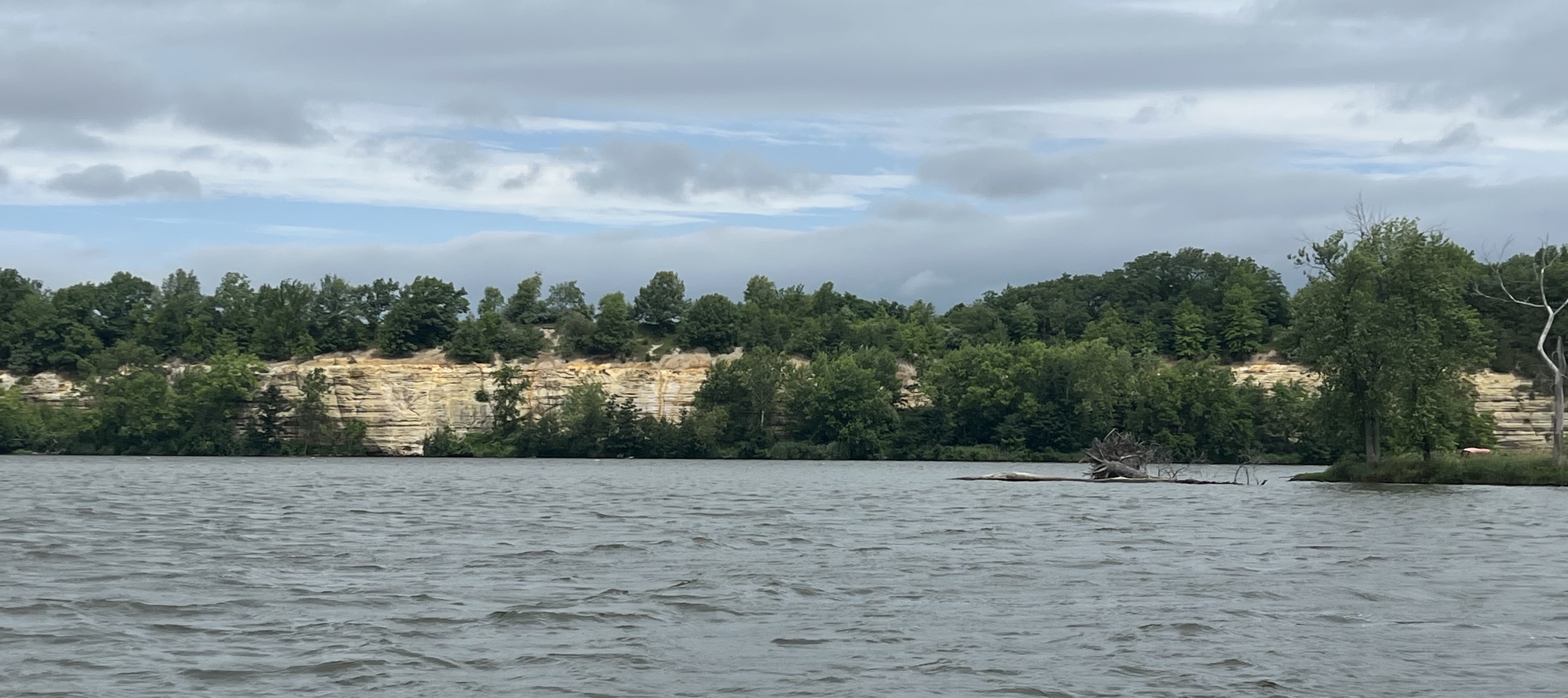
We arrived at Starved Rock Lock just ahead of a solo Looper in a homemade boat, and both tied up to barge mooring cells while we waited for a northbound “double” tow to lock up. After the barges were winched out of the lock, the two of us locked down, swerved around the remaining barges and tug and were on our way, passing a half-dozen pleasure craft waiting to lock up. At Peru, IL, we passed the Michael J. Grainger, which was unloading cargo. The Starved Rock region of the state is quite beautiful, with sandstone bluffs visible in many places. The name comes from an 18th-century native legend, when a group of Illinois were trapped on a high bluff and surrounded by their enemies, eventually dying of starvation.

Starved Rock sandstone bluffs


Winching barges out of Starved Rock Lock

It was a 35-mile day with just the one lock, and we tied up at 3:30 PM at Big Bend Marina in Hennepin, IL, population 741. Fran, the owner and manager, was waiting for us, caught our lines and gave us the scoop on the tiny hamlet. She and her husband just opened up two months ago, relocating the marina from Henry, IL, 11 miles downriver.

Big Bend Marina, Hennepin, IL

We were the only diners at Rolando’s Supper Club, an old-time, family-run restaurant that served huge portions of comfort food. The host/server/bartender was a Wisconsin transplant and we had a nice conversation about small town living, Looping and all things cheesehead. Kathleen and I strolled around the village, stopping at the local grocery/hardware store then relaxed on Dragonfly watching the river go by until bedtime.

Bonus Question: (Another anagram—hope you love them as much as I do!) What current world capital city is an anagram of the previous capital? (answer at end of post)

Photo Journal: 

Father Louis Hennepin fountain

Rolando’s Supper Club decor

Hennepin, IL veteran’s memorial and courthouse

And to think that I saw it on Mulberry Street

Bonus Question Answer: Originally called Edo, Tokyo is an anagram of Kyoto, Japan’s prior capital. Tokyo means “east imperial capital” in Japanese, while Kyoto means “imperial capital.”

Friday, June 27, 2025

Joliet to Ottawa, IL

Yesterday was a long, hot, challenging day, but we persevered and continued on our adventure. Our first “hurdle” was getting under the Chicago, Rock Island and Pacific Railway Bridge in Joliet, about 300 yards from where we spent the night. While preparing to get underway, we heard a siren and watched in surprise as the normally-open bridge descended to the closed position, which meant that a train was coming. With a posted vertical clearance of 9.5 feet and varying water levels, this was uncomfortably close to our air draft of 9 feet. Our options were either wait for the bridge to reopen or make ourselves shorter. We did the latter, by disconnecting and dropping our masthead light, and we cleared the closed bridge by about a foot. 

At the Joliet wall. Railroad bridge is up.
Pro tip: we put pieces of an old garden hose around
our dock lines to prevent chafe on rough walls.

Bridge is down, but we got under it

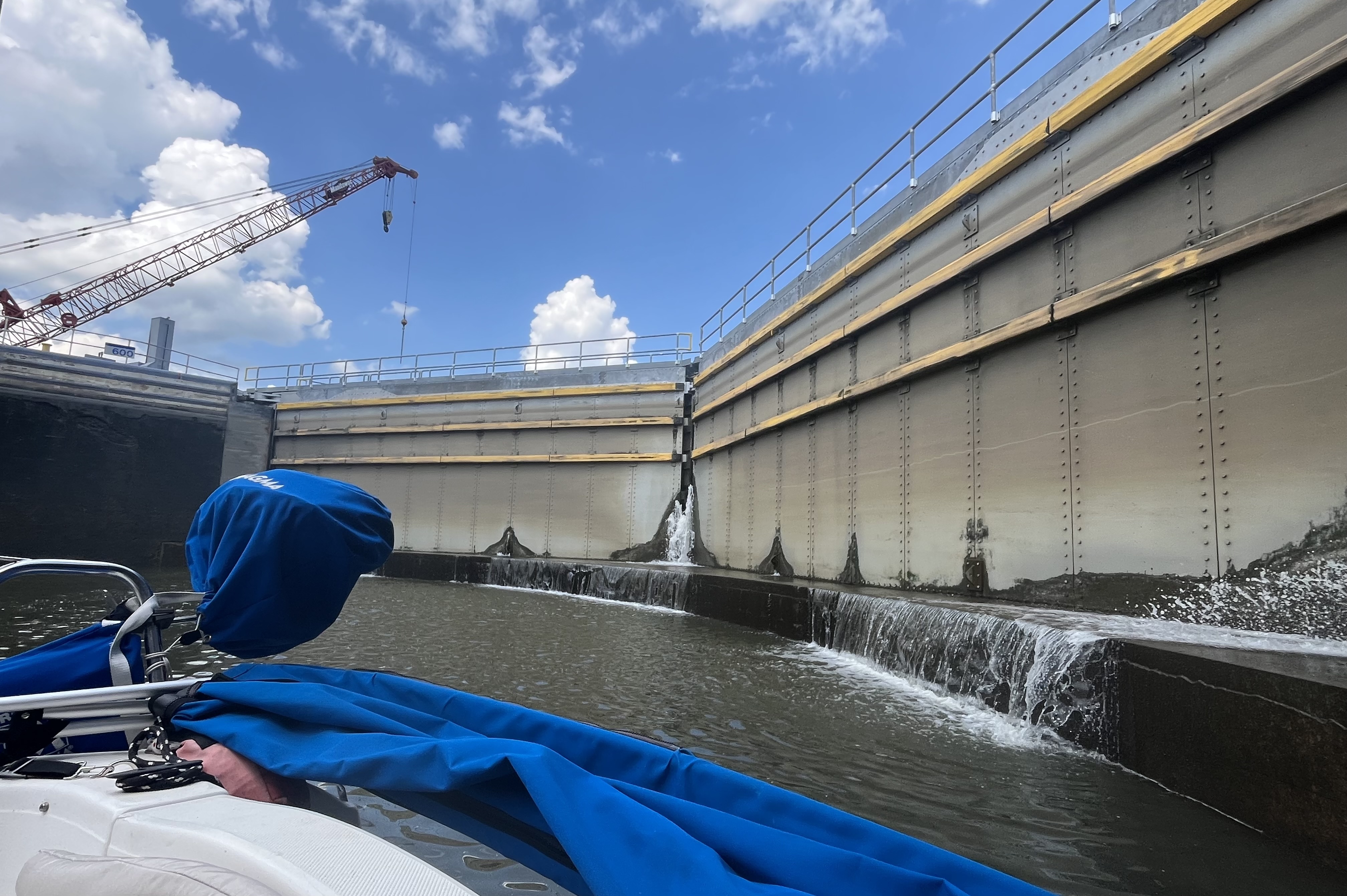
At the Brandon Road Lock, we had a half-hour wait to enter and then another half-hour to slowly drop the 34 feet. According to the Lockmaster, the Army Corps of Engineers is dredging the channel downstream and preparing to install more invasive aquatic species barriers, so they have to dump water extra slowly. The scenery is now quite beautiful, a welcome break from the bank-to-bank heavy industry closer to Chicago. There are still many commercial areas, but they are more scattered, with much of the river looking very natural. 


It was at the Dresden Island Lock, that the fun began. Spoiler alert—there were no catastrophes, but we did arrive at the same time as the Michael J. Grainger, a nine-barge tow, which had priority over us as a commercial vessel. The Grainger was a “split” or “double,” in towboat lingo, which means that it’s too big to fit in the lock as one unit and has to break up into smaller parts to get through the lock. We motored in place for two hours while the barges were loaded in the lock chamber, the tug was disconnected and backed out, the barges locked down, then were winched out and secured to the guide-wall. Then the chamber was refilled and the tug went in the lock. Fortunately, the Lockmaster and tow captain agreed to let us lock through with the tug. This was a pleasant surprise and a first for us, since commercial and recreational vessels are typically locked separately. After another super slow drop of 20 feet, we had to wait for the tug to exit, reconnect to his barges and push out of the lock. The tow captain couldn’t have been nicer and more professional, and as soon as there was room, he stopped to let us pass before we both continued downriver. The whole process took three hours—a very long time, but at least we got to watch a show.

The Michael J. Grainger entering Dresden Island Lock

In the lock with the Grainger

Upriver lock doors and sill plate

The Grainger reconnected and pushing out.
We squeezed around him to the right!

There were 29 miles until the next lock, so we pushed Dragonfly hard to put as much distance as possible between us and the Grainger, so we wouldn’t have to wait for them again at the next lock. I hate stressing our outboard and burning gas unnecessarily, but it was yet another hot and humid day, with a high of 92F, it was getting later in the afternoon, and we didn’t want to be on the river after dark. We slowed only to reduce our wake when passing by marinas and anchored boats, and during a passing thunderstorm, which reduced our visibility. The soaking felt great, and washed at least some of the sweat off of us. 

We got to Marseilles Lock (pronounced “marsaylz” here) well ahead of the Grainger, but had to wait for another big tow (luckily not a “double”) to lock up and exit before we dropped 26 feet and were on our way. Two miles later, we docked at Heritage Harbor Marina in Ottawa, IL, tying up at 7:50 PM. We quickly put the boat to bed to get to the marina’s restaurant before its advertised closing time of 9:00 PM, but were deeply disappointed to learn that they hadn’t opened that day (“sorry for the inconvenience”). Kathleen whipped up a cold tuna salad, and while eating in the cockpit, a woman patrolling the docks with a broom warned us to watch out for marauding raccoons that had been boarding boats and stealing food (we never saw them). After dinner we took long showers at the marina’s bathhouse, then returned to our still-stuffy boat as the sun was setting. We stayed awake just long enough for a game of cribbage, then fell fast asleep. Map link: Heritage Harbor Marina

Ottawa, IL, was the site of the first of seven Lincoln-Douglas debates in 1858. Republican Abraham Lincoln was the challenger against Democratic incumbent Stephen Douglas for his U.S. Senate seat. The debates attracted thousands and were focused mainly on the issue of slavery. While Lincoln lost the 1858 Senate election (Fun fact: Senators back then were elected by state legislatures, not the public), the debates raised his national profile and helped propel him to victory in the 1860 presidential election, when he defeated John Breckinridge, John Bell and Stephen Douglas.

Bonus Question: Which of the following fictional characters have stars on the Hollywood Walk of Fame? (answer at end of post)
A. Godzilla
B. Mickey Mouse
C. Snow White
D. All of the above

Our cabin thermometer, and lucky green turtle  

Bonus Question Answer: D—all of the above. Kermit the Frog, Bugs Bunny, Donald Duck, Lassie and Big Bird also have Hollywood stars.

Wednesday, June 25, 2025

Hammond, IN, to Joliet, IL.

After a decent night’s sleep with cooler temperatures and only a couple of train horns, we left Hammond Marina at 7:30 AM and ventured out onto Lake Michigan. The light northeast wind  stirred up a gentle swell that bounced our little boat but was not unpleasant. We pointed the bow for the foggy Chicago skyline 15 miles away, and eventually could make out the ferris wheel on Navy Pier, which was a perfect visual waypoint. We soon arrived at the Chicago Harbor Lock, who put us right through for the one-foot drop into the Chicago River. Upon exiting the lock, there was a transformation from the quiet lake to an extremely busy waterway. We immediately had to dodge a firefighting boat, a kayak class and three tour boats (one conducting man overboard drills). Despite the traffic, taking our own boat through Downtown Chicago was a bucket list item and an amazing experience!


Navy Pier

Can you find Trump Tower?

There are 18 bridges in Downtown Chicago

After passing through the main population and business center of the city. the scene was commercial, with tows, barges and workboats of all kinds, often moored on both sides of the river, narrowing the available channel. Eventually the Chicago River became the 28-mile Chicago Sanitary and Ship Canal, completed in 1900 to replace the Illinois & Michigan (I&M) Canal, the original waterway connecting Lake Michigan to the Des Plaines and Illinois Rivers. See our March 1 post for more info on the waterway and our route: 2025 Planning: The Illinois Waterway. After a 40-foot drop at Lockport Lock, we merged with the Des Plaines River just upstream of Joliet, IL. After 55-miles on yet another day of scorching heat and brutal humidity, we tied up to the free wall at Bicentennial Park, across the river from the city police station and a Harrah’s Casino. Map link: Joliet, IL


From our chartplotter—you can see the I&M
Canal, Chicago Ship and Sanitary Canal and
Des Plaines Rivers side-by-side

Today we passed under the Atchison Topeka & Santa Fe railroad bridge, which at 19 feet and change, is the lowest fixed bridge on America’s Great Loop—if you can’t get under it, you can’t do the Loop. Near Romeoville, we transited through the Electric Dispersal Barrier System, which is an underwater, electric fence to keep invasive aquatic species, primarily Asian carp, out of the Great Lakes. 


There were very few recreational vessels out. One notable one was a northbound Looper that we met twice in the autumn of 2023 in Alabama, who snapped this nice pic of Dragonfly.

Photo courtesy of M/V Toscana

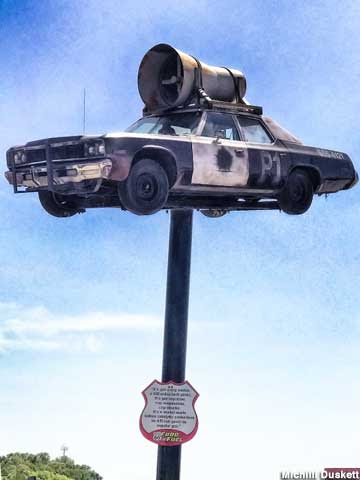
After securing the boat in Joliet, we walked along the river through a lovely park, then ate dinner at a Korean restaurant, YURA NUNA, both enjoying beef bulgogi rice bowls and ice-cold lemonade. Joliet, IL, population 150,000, is the third-largest city in Illinois, after Chicago and Aurora. It was named after Father Louis Joliet, who paddled here in 1673 with Father Jacques Marquette and camped nearby. The first Dairy Queen opened here in 1940, although the building is now a small church. Actors Melissa McCarthy and Nick Offerman were born here. And the opening scene of the 1980 movie The Blues Brothers was shot at the Old Joliet Correctional Facility, which is now a tourist attraction. A replica of the 1974 Dodge Monaco “Bluesmobile” can be found at a truck stop three miles south of town, atop a 20-foot pole.

Bonus Question: What stretchy fabric is an anagram of its primary function? (answer at end of post)


Bonus Question Answer: “Spandex” is an anagram of “expands.” Introduced in 1959 by DuPont under the trade name Lycra, spandex was developed to replace rubber girdles. Its fibers can stretch more than 500% without breaking and return to their original length.


Tuesday, June 24, 2025

We’re cruising again! Lake Michigan, East Chicago and Hammond, IN

Dragonfly is on the move again. We hitched her up yesterday and drove 390 miles to East Chicago, IN, where we spent the night in air conditioned comfort at the Ameristar Casino Hotel. Our original plan was to drive down on Sunday to avoid weekday Chicago traffic, but we delayed our departure by a day due to high heat and high winds. Conditions on Monday did not improve, with a high temperature of 98F, tropical humidity and wind gusts into the 30s—we decided to travel anyway, but opted not to launch the boat and sleep aboard in the sweltering heat. Chicago traffic was as bad as we’ve seen it, and maneuvering during rush hour hauling a 30-foot boat trailer was pretty stressful. To get to the Ameristar, we drove for miles through an enormous industrial area and found the casino nestled between a small marina and a beautiful public beach, all surrounded by steel mills and coal plants. We ate dinner in the hotel’s sports bar, then watched reruns of The Office until we fell asleep.

This morning we arrived at Hammond Marina around 9:00 AM, checked in, launched Dragonfly into Lake Michigan without incident, motored to the fuel dock to take on gas, then to our assigned slip, where we began to rig the boat for cruising. We dropped off our trailer at our storage location, then ate lunch in town and bought provisions. It was another hot, humid day, with a high of 97F, but an afternoon front brought a few rain showers and a wind shift from south to north, bringing cooler air in from the lake. Map link: Hammond Marina

Indiana is the 13th state that we’ve visited on the Great Loop, and we’ve now completed our HOMES Certification, having boated on all five Great Lakes: Huron, Ontario, Michigan and Erie on Dragonfly and 25 years on Lake Superior aboard a collection of different sailboats. 

We are less than a mile from the Illinois-Indiana state line, and still in the Central Time Zone. Six counties in northwestern Indiana observe Central Time due to their proximity to Chicago. Another six counties in southwest Indiana are also on Central Time, with the remaining 80 counties on Eastern Time. Fun fact: Indiana did not adopt statewide daylight saving time until 2006. Apparently, time zones are a touchy subject here, and you can get a rise out of many Hoosiers by bringing it up. Bonus Question: When did the United States begin using time zones? (answer at the end of post).


Bonus Question Answer: In November of 1883, our four standard time zones (Pacific, Mountain, Central and Eastern) were established, not by the U.S. Government, but by the nation’s railroads in order to better synchronize and schedule rail traffic. Before then, most locales in the country set their own time, based on the position of the sun. In the late-19th century, there were more than 140 local times, complicating rail schedules and resulting in delays, missed connections and collisions. Railway executives agreed that something had to be done, and unilaterally implemented our current system of four time zones. There were pockets of resistance from those who resented the railroads’ arrogance, the loss of local autonomy and even the “disregard for God and nature,” but the switch quickly became accepted. Interestingly, the United States Congress would not formally adopt the Standard Time Act until 1918. Fun facts: Russia has 11 time zones, while all of China operates on Beijing Standard Time. 

Violins of Hope

Last Sunday, we attended a concert at The Museum of Russian Art in Minneapolis as part of an exhibit, “Violins of Hope: Honoring Memory Thro...